
The LowSlider motion platform
Why motion changes everything
Many sim racers hit a ceiling with direct-drive wheels, load-cell pedals, and ultrawides. Yet, something still feels missing when chasing lap times or racecraft. Adding a high-end sim racing motion platform finally brings braking forces, weight transfer, and loss of grip into your body—not just your eyes and hands.
With the LowSlider 6DoF motion simulator, that transformation comes from controlled movement across six degrees of freedom: roll, pitch, yaw, surge, sway, and heave. Each is tuned directly to telemetry, so you feel every kerb strike, elevation change, and weight shift as they happen. Real-world drivers and advanced amateurs use 6DoF motion systems to accelerate learning car balance and recovery, since your inner ear recognises cues you would get on track in a real car.
Low-profile engineering for home use
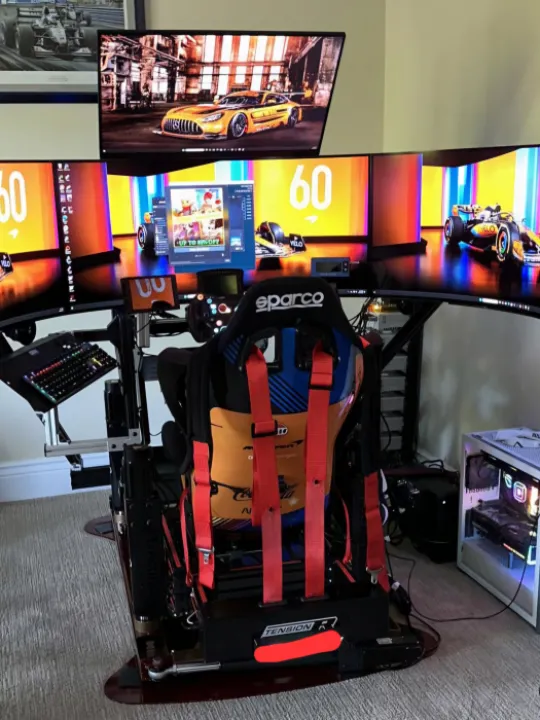
Traditional full-frame motion rigs can be tall, heavy, and visually dominating. This is a problem if your racing space is a spare room or shared office. The LowSlider is a low-profile, floor-hugging chassis that keeps your seating close to the ground. It looks and feels like a compact home sim racing rig upgrade rather than an industrial test rig.
Race At Home markets the LowSlider to bring “motion for the masses” into real homes, with staged builds that can start with a basic motion configuration and grow into a full 6DoF system as budget allows. A Facebook announcement highlights a LowSlider 6DoF package with seven actuators, starting at around £8,600 plus shipping and taxes, positioning it firmly in the enthusiast and prosumer bracket while remaining competitive with many imported systems once duties and logistics are factored in.
Six degrees of freedom in practice
A basic seat mover can’t match a true high-end sim racing motion platform. Only a full 6DoF system fully reproduces the six axes of motion your car experiences on track. It combines roll, pitch, and yaw with heave, sway, and surge, so the platform tilts, shifts laterally, and moves vertically beneath you.
Surge simulates the push in your back under acceleration and the forward pitch when you brake hard. Sway reproduces the side load as you turn in and carry speed through a bend. Heave lets you feel crests, compressions, and kerbs as short, sharp vertical motions. This is essential for rally stages or bumpy circuits. Sim Racing Studio’s motion tuning guidance shows how telemetry profiles let you scale these effects. The LowSlider can be configured for subtle training movement or aggressive, theme-park-style motion, depending on your preference.
Traction loss, surge, and that race feeling
Many experienced sim racers recommend platforms like the LowSlider over cheaper systems. These platforms convincingly reproduce traction loss and surge. When the car’s rear starts to slide, a dedicated traction-loss axis quickly rotates or shifts the rig about the vertical axis. Your body receives a clear cue that the rear end is stepping out, even before your eyes register it.
A popular YouTube review highlights the LowSlider’s strong traction loss and surge performance with PT Actuator hardware. This setup lets you feel hard braking, gear shifts, and oversteer as distinct movements rather than generic shakes. Combined with Sim Racing Studio profiles and sims that output rich telemetry, it provides realistic race-car motion feedback. This helps you modulate brake pressure, catch slides, and commit to corner entry with confidence.
Built by a specialist UK supplier
For UK and European buyers, the LowSlider offers a practical advantage. It’s manufactured by RACE@HOME LTD, a Leicester-based manufacturer focused on sim racing hardware and custom motion platforms. Users and reviewers describe the company as a motorsports and sim-racing specialist serving enthusiasts, not just a general electronics store.
Trustpilot shows Race At Home with a high 4-star rating based on dozens of reviews. Many 6DoF LowSlider owners praise build quality, communication, and after-sales support. Customers mention dealing directly with the owner and highlight careful packaging, on-time delivery, and setup help long after installation. This support matters when investing several thousand pounds in a complex home sim racing rig.
Staged builds and long-term value
Race At Home promotes staged builds for its LowSlider. Buyers start with a core motion base and add actuators and features over time. This spreads out the cost and aligns with the number of enthusiasts who upgrade their wheelbases, pedals, and displays step by step. From a value perspective, paying once for a robust, low-profile chassis designed to accommodate future actuators can be more efficient than buying and selling multiple lower-tier motion systems along the way.
Owners on Trustpilot describe using their Race At Home motion rigs daily for years, with the company still offering advice and compatibility support for new games and accessories, suggesting a long usable life and ongoing support rather than a disposable purchase. When combined with domestic stock and servicing in the UK, that long-term horizon can make the overall cost of ownership competitive against cheaper platforms that require international shipping for spares and support.
Who does the LowSlider suit best?
Based on public pricing, configuration and community feedback, the LowSlider is clearly aimed at serious enthusiasts who have already invested in strong PC hardware and quality controls and now want their next step to be full motion. If you run demanding sims, already understand concepts like weight transfer and trail braking and care about consistency as much as outright speed, a high-end sim racing motion platform like this will give you more usable feedback than a simple vibration-based solution.
It also suits sim flyers who want to experience pitch, roll and heave changes during takeoff, turbulence and aerobatic manoeuvres, since the same 6 degrees of freedom motion system can run profiles for both flight titles and racing. Buyers who share their space with family benefit from the low-profile design and staged upgrade options because the rig can grow in capability without suddenly taking over the room or requiring structural changes.
Bringing pro-level motion to the home
A decade ago, full 6DoF rigs were mostly confined to driver training centres and commercial flight simulators, but platforms like the LowSlider show how that experience can now live in a normal house. With a compact chassis, a seven-actuator layout on top-tier builds, and strong traction-loss and surge capability, the system is engineered to deliver realistic race-car motion feedback while still being suitable for real-world use.
If you are researching motion options and wondering whether to go with a cheaper, limited-DoF platform or commit to a serious home sim-racing rig upgrade, the LowSlider is worth shortlisting for its UK-based build, staged expansion path and track record of happy owners. Take time to define what you want to feel on track, talk to Race At Home about the right LowSlider 6DoF motion simulator configuration for your space and budget, and consider booking a demo or watching detailed setup reviews to experience how full motion changes your driving before making the leap.
Read More: Why Motion Matters | How Motion Platforms Work
About Us
Race@home launched in 2020, offering immediate shipment of high-end sim hardware to frustrated customers. Our acclaimed LowRider 5DOF and new LowSlider 6DOF platforms prioritise compact excellence.
Contact Us
raceathome@gmail.com
+447988775662
Leicester, United Kingdom
WhatsApp
Instagram
Facebook
TrustPilot
YouTube