
Actuators for Your Home Racing Rig
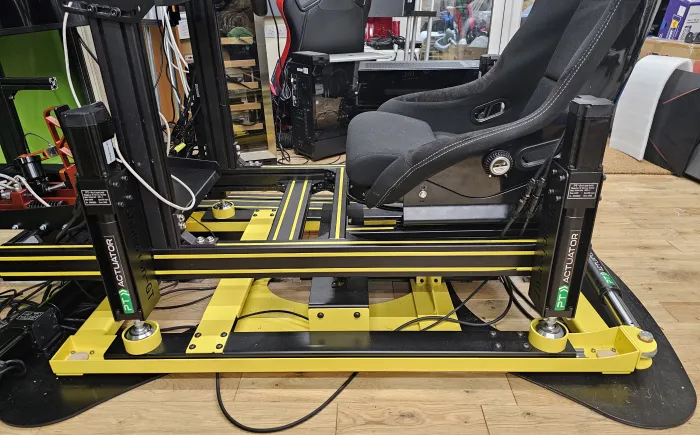
Actuators and the art of realism
There’s a moment in sim racing when the machinery beneath you disappears. The screen, the chassis, even the seat – it all fades – and you feel as though you’re really on the circuit. That illusion, the one that makes your chest tighten as the rear tyres edge wide through a corner, isn’t created by the game alone. It’s the work of actuators: the mechanical core of any serious sim racing motion platform.
An actuator translates digital signals into movement. It’s the device that pushes, tilts, and lifts the simulator in real time to match the car’s behaviour on-screen. In the simplest terms, a linear actuator converts rotational motion from a motor into precise linear motion. In practice, it gives life to the frame you’re sitting in. A well-tuned system makes braking feel heavy, acceleration light, and road camber almost tangible. Bad actuators, or poorly calibrated ones, break that spell entirely.
How race rig actuators differ
The actuator market for simulators isn’t vast, but it’s diverse. Most products fall into three categories: electric, hydraulic, and pneumatic. All can generate realistic motion; how they do it, and at what cost, is where they differ.
Electric actuators are by far the most common today. They utilise servo motors and screw-driven mechanisms to achieve fast, precise movement. The latest versions run brushless motors paired with high-resolution positional sensors – a combination that produces smooth, consistent motion without a trace of lag. For home setups, they’re hard to beat. They’re quiet, reliable, and require almost no maintenance beyond the occasional inspection. It’s no coincidence that nearly every modern sim racing motion platform is electric.
Hydraulic systems, still favoured by professional teams and research facilities, operate in an entirely different way. Instead of electricity driving a screw, pressurised oil pushes a piston. Hydraulics are brutally powerful, capable of recreating the G-forces felt in an actual race car, and they respond instantly. The downside is complexity. They require pumps, filters, and fluid management systems and often leak or overheat after prolonged use. They also take up far more space – great for a racing academy, but too much for a spare room.
Then there are pneumatic actuators, which use compressed air to drive movement. At first glance, they seem ideal: quick, responsive, and relatively affordable. But air’s compressibility is both a blessing and a curse. The motion often feels cushioned, with a slight delay that robs the tactile crispness racers want when hunting for grip. As a result, pneumatic systems are rarely the primary source of motion in sim rigs. They’re more often used to add fine details, like engine vibrations or road texture.
For most serious enthusiasts or small-scale professional operators, electric linear actuators strike the best balance. They offer considerable speed and precision without the noise, weight, and upkeep of hydraulic systems. And because the technology behind them mirrors that used in robotics and automation, prices have become more approachable in recent years.
Decoding the degrees of freedom
The next piece of the puzzle is movement capability, measured in degrees of freedom (DOF). This describes the number of directions, or axes, in which the simulator can move.
A 2DOF rig moves in pitch and roll, tilting forward for braking and side-to-side through corners. Even this simple setup adds a surprising sense of inertia. Move to 3DOF by adding heave (vertical lift), and the experience changes entirely. You can feel the weight of the car settle into the suspension or pop up over a crest. With one more actuator, yaw comes into play, introducing that sideways drift when the rear steps out.
At the top end, 6DOF platforms deliver motion on all three axes (heave, surge, sway) plus three rotations (pitch, roll, yaw). It’s the complete package, capable of mimicking anything from a tight chicane to a tank slapper. These systems are used by race teams and driver schools where fidelity matters as much as fun. But the more actuators involved, the more critical calibration becomes. Each linear actuator must move in perfect synchrony with the rest, otherwise the illusion collapses into a juddering mess. Alignment, stroke length, and controller latency all need fine-tuning.
The names behind the technology
Several manufacturers now dominate the space, each with its own focus. D-BOX, based in Canada, might be the most recognised. Initially building motion systems for the film industry, they turned to sim racing and achieved outstanding results. Their actuators are smooth, nearly silent, and fully integrated with leading esports platforms such as iRacing. D-BOX equipment isn’t cheap, but it’s the definition of refinement.
Further up the technical scale, Motion Systems in Poland produces industrial-grade setups used in driving and aviation simulators. Their equipment uses servo-based technology with excellent motion resolution. These systems often appear in commercial or research installations, but a few dedicated enthusiasts with deep pockets have installed them at home.
For those working on a budget or building their own rigs, PT-Actuator has built a strong following. The company’s electric actuators are rugged, configurable, and backed by straightforward integration software. They’re particularly popular among hobbyists who want near-professional performance without turning their homes into workshops.
Then there’s SFX-100 – more of a movement than a brand. An open-source project originating from the sim racing community, it utilises widely available industrial components to create a DIY motion platform. Builders source parts themselves, assemble the actuators, and calibrate through shared software. It’s not plug-and-play, but it delivers extraordinary performance for the cost, and there’s a large community of users constantly refining the design.
Other notable names include Qubic System, known for its modular 6DOF setups, and Motion House, which supplies integrated simulator systems to commercial operators in Europe. Between them, these firms have made motion technology more accessible and reliable than ever before.
Fitting, calibrating, and making it work
Installing actuators isn’t just about screwing them into the frame. The rig’s entire structure must be robust enough to handle the shifting loads. Aluminium extrusion frames are commonly used for this reason: they’re stiff, lightweight, and relatively easy to modify. Each actuator must be mounted precisely so that its travel aligns with the platform’s intended geometry. Any misalignment, even by a few millimetres, can cause twisting or premature wear.
Power supply is another key consideration. Electric actuators can draw between 200 and 800 watts apiece, depending on size and speed. A four-actuator setup can place a significant demand on a household circuit. It’s wise to plan for adequate voltage and grounding. Once installed, the system connects to a motion controller that interprets telemetry data from the simulation. Software such as SimTools help align the timing between in-game cues and physical motion.
Noise control is also part of the experience. Even quiet actuators can transmit vibration through the floor, so many users isolate the platform with rubber mounts or composite pads. When tuned well, motion feels immediate but never distracting. It doesn’t need to toss you about; subtlety is the real mark of quality.
For racers, these systems aren’t just toys. Motion platforms help develop a better feel for traction, load transfer, and braking consistency. Professionals use them to rehearse race lines or learn unfamiliar circuits without burning tyres or fuel. Beyond motorsport, there’s a growing demand in driver safety and product testing sectors, too. The technology’s realism is crossing over into training, giving it value far beyond the gaming market.
Looking into the future
Actuator development is accelerating fast. Newer linear actuators feature lightweight composite housings, smart servo drives, and built-in sensors that automatically manage temperature and wear. Future systems are expected to adapt in real time, changing motion profiles based on driver input or environmental conditions. As motorsport technology trickles down to living rooms, the line between simulator and reality is narrowing.
For anyone building a home rig today, the decision isn’t just about price or performance. It’s about trust—trusting that when you brake hard, or thread the car through a corner on the limit, the motion beneath you responds truthfully. Choose well, and your simulator stops being a machine altogether. It becomes a car you can feel.
Read More: Why Motion Matters | Choosing Race Pedals
About Us
Race@home launched in 2020, offering immediate shipment of high-end sim hardware to frustrated customers. Our acclaimed LowRider 5DOF and new LowSlider 6DOF platforms prioritise compact excellence.
Contact Us
raceathome@gmail.com
+447988775662
Leicester, United Kingdom
WhatsApp
Instagram
Facebook
TrustPilot
YouTube