
3DOF Motion Platform Sim Racing
3DOF Motion Platform Sim Racing: The Ultimate Upgrade Guide for 2026
For the serious sim racer, the journey towards ultimate immersion is a constant pursuit of realism. You have the direct-drive wheel and the load-cell pedals, but a crucial sensory dimension remains untapped. Discover how a true 3DOF motion platform, focused on traction loss and surge, delivers the critical handling cues for performance driving, moving beyond simple tilting to become a genuine training tool, not just an immersive toy.
Table of Contents
- Understanding 3DOF Motion Platform Sim Racing: The Immersion Sweet Spot
- 3DOF vs 6 DOF: Which Motion Simulator is Right for You?
- The LowSlider Advantage: Ultra-Low Profile and Bespoke Engineering
- How to Set Up Your 3DOF Motion Rig in Under One Hour
- Maximising Immersion: VR and High-End Accessories for 3DOF
Understanding 3DOF Motion Platform Sim Racing: The Immersion Sweet Spot
The term "3DOF" is widely used in the sim racing world, but it often leads to a fundamental misunderstanding. Many associate it with basic systems that simply tilt and shake the driver. This approach, whilst entertaining, fails to deliver the critical information a driver needs to find the limit. A genuine performance-focused 3DOF motion platform is not a toy for immersion; it is a precision-engineered tool for car control, built around the three most important handling cues you feel in a real performance car.
This physical feedback is the missing link for many advanced sim racers. It translates abstract telemetry data from games like iRacing or Assetto Corsa Competizione into tangible, physical sensations. This allows you to develop muscle memory, react instinctively to the car's behaviour, and consistently push closer to the edge of adhesion. It’s the difference between seeing you’re losing the rear on a screen and feeling the chassis begin to rotate beneath you.
The Common 3DOF Misconception: Pitch, Roll, and Heave
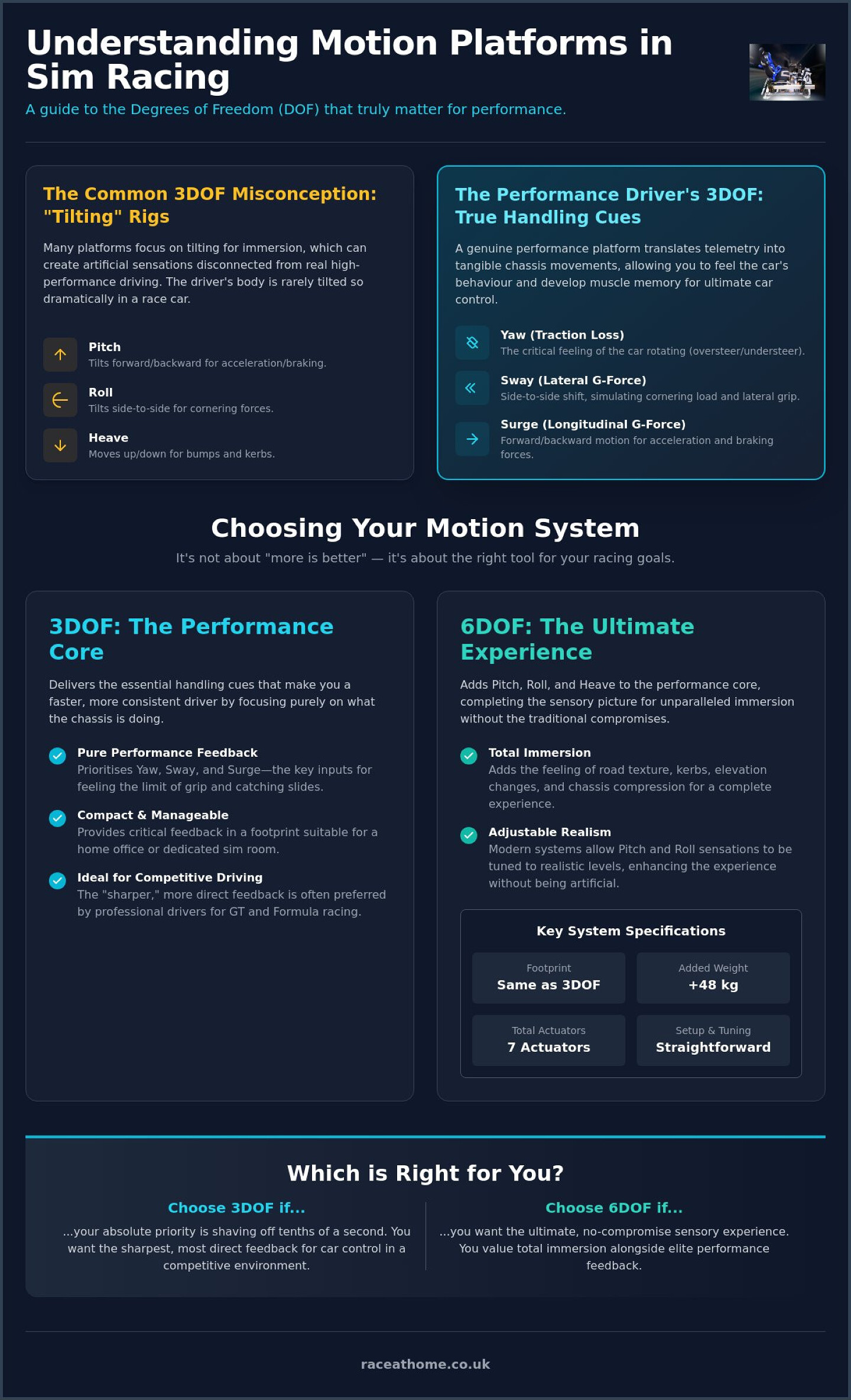
Many commercially available motion systems define their three degrees of freedom as Pitch, Roll, and Heave. This is what we call a "tilting" platform. Let's break down what they do:
- Pitch: The rig tilts forwards and backwards to simulate acceleration and braking.
- Roll: The rig tilts side-to-side to simulate cornering forces.
- Heave: The rig moves up and down to simulate bumps, kerbs, and road texture.
Whilst these motions add a layer of immersion, they are a compromise. In a real GT or formula car, the driver's body is held so rigidly by the seat and harnesses that the sensations of pitch and roll are minimal. Your inner ear isn't being tilted up, down, and side-to-side. Instead, you feel sustained G-forces pushing you into your seat. A tilting platform cannot replicate these sustained forces; it can only provide a brief initial cue before it has to return to its central position. This creates an artificial experience that is fundamentally disconnected from high-performance driving.
The Performance Driver's 3DOF: Yaw, Sway, and Surge
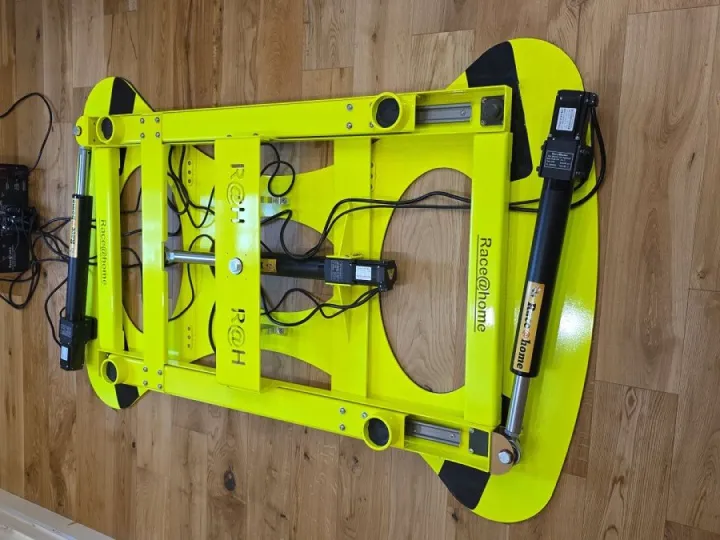
The LowSlider 3DOF platform was engineered from the ground up to reject the compromised "tilting" model. It focuses exclusively on the handling cues required for optimum performance and lap times. This is a motion platform as a serious training tool. The three degrees of freedom it delivers are:
- Yaw (Front & Rear Traction Loss): This is the critical sensation of the car rotating. When the rear tyres lose grip in oversteer, you feel the back of the rig step out. When you experience understeer, you feel the subtle rotation as the front tyres scrub for grip. This is the single most important cue for catching a slide and maintaining control at the limit.
- Sway (Lateral G-Force): This is the feeling of the car shifting its weight laterally. As you turn into a corner, the platform shifts sideways, simulating the powerful forces pushing you against the side of your seat. It’s a direct, 1:1 translation of lateral grip.
- Surge (Longitudinal G-Force): This is the powerful shove in the back you feel under hard acceleration and the intense pressure against your harnesses during braking. The platform physically moves forwards and backwards to replicate these forces with startling accuracy.
By focusing on Yaw, Sway, and Surge, the LowSlider provides a pure, uncompromised feedback loop. You are not being tilted; you are feeling the precise movements of the car’s chassis. This allows you to identify the limit of grip intuitively, correct slides before they become unrecoverable, and brake later and harder with confidence.
3DOF vs 6 DOF: Which Motion Simulator is Right for You?
The debate between 3DOF and 6DOF is not as simple as "more is better." It's about choosing the right tool for the job. For the home user concerned with performance, space, and complexity, a performance-focused 3DOF system like the LowSlider often represents the ultimate sweet spot. It delivers all the essential handling cues without the enormous footprint and cost of a full 6-axis rig.
A 6DOF system adds the axes of Pitch, Roll, and Heave to the foundational Yaw, Sway, and Surge. This completes the sensory picture, adding in the feeling of road texture, elevation changes, and chassis compression over crests. The LowSlider platform delivers both the 3 and 6 DoF systems utilising the same compact footprint and easy build.
The Complexity of 6 DOF Systems
A full 6-axis motion platform is neither complex or technically challenging, although 2 people are essential to complete the build. We exclusively use the Sim Hub motion software to communicate between the PC and the motion platform using 2 USB cables and a standard domestic supply. Sim Hub collects data about the stroke and location of the actuators, and automatically creates a baseline tuning profile which can be easily tweaked by the user to deliver the optimum feel.
The 3DOF Value Proposition
A high-fidelity 3DOF platform delivers the core sensations that make you a faster, more consistent driver. It's about prioritising the information that matters most for performance.
- Essential Cues, Compact Package: You get 100% of the critical handling feedback—traction loss and G-forces—in a footprint that is manageable for a home office or sim room.
- "Set and Forget" Simplicity: By focusing on the most important axes, software setup is more straightforward. You can spend more time driving and less time tweaking profiles.
- Home-Friendly Design: The LowSlider is engineered to work with standard home power outlets and flooring, removing significant barriers to entry for high-end motion simulation. When you are ready for the ultimate in immersion, the LowSlider 6DOF is available for professional training and no-compromise setups.
The LowSlider Advantage: Ultra-Low Profile and Bespoke Engineering
In a market dominated by mass-produced, industrial-looking rigs, the LowSlider stands apart. Every platform is hand-built to order in the UK, reflecting a philosophy that prioritises engineering integrity and driver connection over assembly line volume. This bespoke approach is not just about aesthetics; it is fundamental to delivering the most accurate and stable motion feedback possible.
Compact Footprint, Full-Scale Sensation
One of the biggest hurdles for aspiring motion rig owners is space. Traditional motion platforms are bulky and intrusive, making them impossible for a shared space like a home office. The LowSlider’s ultra-low profile and compact design solve this problem.
- Space-Efficient Design: The LowSlider is engineered to fit into spaces where other motion rigs simply cannot, bringing high-end motion to a wider audience without demanding a dedicated room.
- Superior Structural Design: Our focus on engineering and build quality results in a chassis that minimises operational noise and vibration, making it a more considerate addition to your home.
PT Actuator Integration: The Heart of the Motion
A motion platform is only as good as its actuators. That's why Race@Home partners with industry leader PT Actuator to provide the electromechanical muscle for the LowSlider. Their high-fidelity linear actuators are the gold standard in professional simulation.
- Industry-Leading Partnership: We integrate the best hardware available to ensure our platform's mechanical design is matched by its electronic performance.
- Precision and Speed: Linear actuators offer unparalleled precision and speed compared to slower, less accurate gear-driven systems. This is essential for delivering the instantaneous feedback needed to catch a slide or feel the texture of a kerb.
- Ultra-Low Latency: The combination of our chassis design, PT Actuator hardware, and optimised software ensures that the time between an event happening in the game and you feeling it is virtually zero.
How to Set Up Your 3DOF Motion Rig in Under One Hour
The prospect of assembling a complex motion simulator can be daunting. Competitors often require hours of following complex manuals or long video tutorials. We believe that getting started should be as seamless as the motion itself. The Race@Home LowSlider was designed from day one for simple, rapid assembly.
Our unique "Four-Piece" shipping philosophy allows us to deliver our hand-built rigs worldwide in a single, well-protected crate. Inside, you will find four main, pre-assembled sections. This revolutionary approach means you can go from unboxing to racing in under an hour, without needing an engineering degree or a garage full of tools.
From Crate to Cockpit: The Assembly Process
The entire process is designed to be intuitive and straightforward, allowing you to focus on the excitement of your first motion-enabled race.
- Unboxing and Layout: Open the crate and lay out the four main chassis sections. All hardware is clearly labelled and organised for a frustration-free build.
- Connect the Chassis: The main structural sections bolt together quickly and easily, forming the rigid, ultra-low-profile base of your new cockpit.
- Mount Your Peripherals: The chassis features pre-drilled mounting points for all major brands of wheels, pedals, and shifters. Attach your favourite gear with ease.
- Plug and Race: Connect the actuators and control box using the simple, pre-configured wiring loom. There’s no complex wiring or electronics knowledge required.
Optimising Your Motion Software
Once assembled, the final step is connecting your rig to the powerful motion software. This interface allows you to fine-tune the experience to your exact preferences and the car you are driving.
- Calibration for Car Classes: A stiffly-sprung GT3 car feels very different to a high-downforce formula car. We provide base profiles and simple tips to help you adjust motion settings for maximum realism in any discipline.
- Adjusting Intensity Levels: Whether you prefer subtle, precise cues or a more aggressive, visceral experience, the intensity of each axis can be easily scaled to match your personal taste.
- Perfect VR Synchronisation: The software ensures that the physical motion of the rig is perfectly synchronised with the visual feedback in your VR headset, creating a seamless and comfortable experience.
Maximising Immersion: VR and High-End Accessories for 3DOF
A 3DOF motion platform provides the physical foundation for ultimate immersion, but to complete the experience, you need visuals and controls that can match its intensity. Pairing your LowSlider with the right accessories creates a no-compromise cockpit that transports you directly onto the track.
Virtual Reality is the perfect partner for motion simulation. A common concern for new users is motion sickness, but a high-fidelity platform dramatically reduces this risk. Motion sickness in VR is often caused by a disconnect between what your eyes see and what your inner ear feels. By providing accurate physical feedback for yaw, sway, and surge, the LowSlider ensures your body feels the movements you are seeing, creating a cohesive sensory experience that is both more immersive and more comfortable.
The Pimax VR Experience
To fully capitalise on the immersion of motion, we recommend Pimax VR headsets. Their industry-leading specifications are the ideal match for a high-performance simulator.
- Unmatched Field of View (FOV): Pimax headsets offer a super-wide FOV, eliminating the "looking through binoculars" effect of other headsets and filling your peripheral vision for incredible situational awareness.
- High-Resolution Displays: Crystal-clear, high-resolution panels allow you to spot braking points and apexes far down the track, just as you would in real life.
- Stable Tracking: The exceptional stability of the LowSlider chassis provides a perfect base for VR tracking systems, ensuring a smooth, jitter-free view of the virtual world.
Professional Sim Racing Accessories
To complete your setup, every point of contact with the car should be of the highest quality. A motion platform will expose any flex or weakness in your peripheral hardware.
- High-End Pedals: A firm, progressive brake pedal with a load-cell sensor is essential. It allows you to modulate braking pressure with the same precision the motion platform provides for chassis feedback.
- Rigid Racing Seat: A stiff, bucket-style racing seat is crucial. It ensures that every subtle cue from the actuators is transferred directly to your body, rather than being absorbed by soft foam padding.
Ready to build the ultimate sim racing setup? It’s time to feel what you’ve been missing. Explore the full range of LowSlider platforms and accessories.
Frequently Asked Questions
What is the difference between a LowSlider 3DOF and other 3DOF platforms?
The key difference is our engineering philosophy. Most 3DOF platforms on the market are "tilting" systems that focus on Pitch, Roll, and Heave. The LowSlider 3DOF is a performance tool focused on Yaw (traction loss), Sway (lateral Gs), and Surge (longitudinal Gs). We deliver the critical handling cues you need to be faster, not just immersive tilting motions.
Is a 3DOF motion platform enough for professional driver training?
Absolutely. A 3DOF platform that accurately simulates traction loss (yaw), sway, and surge provides the most vital information a driver needs to learn car control at the limit. For pure performance training, these three axes are more important than the additional environmental cues of a 6DOF system.
Do I need a special floor or reinforced room for a motion rig?
No. The LowSlider is specifically designed for home use. Its excellent weight distribution and efficient design mean it can be safely used on standard household flooring without the need for any structural reinforcement.
How does motion feedback help reduce sim racing motion sickness?
Motion sickness is often caused by a mismatch between what your eyes see and your inner ear feels. By providing accurate physical motion cues (especially for rotation/yaw) that match the visual information in your VR headset, the platform helps your brain create a cohesive sense of movement, significantly increasing comfort.
Can I upgrade a 3DOF LowSlider to 6 DOF later on?
Yes, the LowSlider platform is designed with a clear upgrade path. If you start with our performance-focused 3DOF system and later decide you want the ultimate in full-immersion, we can provide the components to upgrade your rig to a full 6DOF specification.
What sim racing games are compatible with 3DOF motion platforms?
Our motion software is compatible with all major sim racing titles on PC, including iRacing, Assetto Corsa, Assetto Corsa Competizione, rFactor 2, Automobilista 2, and many more. If a game outputs telemetry data, chances are you can race it with motion.
Is the assembly truly under one hour for the LowSlider?
Yes. Our unique four-piece shipping system means the most complex parts are pre-assembled at our UK workshop. The final assembly process is simple, intuitive, and designed to be completed by one person in under 60 minutes.
How much space do I actually need for a 3DOF setup?
The LowSlider 3DOF has a remarkably compact footprint. Whilst exact dimensions vary slightly with seating position, a typical setup requires a space of approximately 1.8 metres in length by 1.0 metre in width, including the full range of motion. This makes it one of the most space-efficient high-end platforms on the market.
About Us
Race@home launched in 2020, offering immediate shipment of high-end sim hardware to frustrated customers. Our acclaimed LowRider 5DOF and new LowSlider 6DOF platforms prioritise compact excellence.
Contact Us
raceathome@gmail.com
+447988775662
Leicester, United Kingdom
WhatsApp
Instagram
Facebook
TrustPilot
YouTube